TL;DR:
- Even with clear water, harmful bacteria and chemical imbalances can still be present and unseen.
- Regular pool water testing is essential to maintain safety, prolong equipment life, and prevent costly repairs.
Your pool water looks sparkling clear, the kids are ready to jump in, and everything seems perfect. But here is the truth that catches many families off guard: crystal-clear water can still carry harmful bacteria, irritating chemicals, or damaging imbalances that you simply cannot see. Water testing is a critical part of pool maintenance, yet it is one of the most overlooked steps for families across Central Indiana.
This guide walks you through everything you need to know about testing your pool water, from understanding what to measure and how to measure it, to interpreting results and taking action with confidence.
Table of Contents
- Why is pool water testing essential?
- Core elements checked during pool water testing
- Common pool water testing methods compared
- How to interpret results and respond to imbalances
- A local perspective: what most families miss about pool water testing
- Dive deeper with Pools of Fun
- Frequently asked questions
Key Takeaways
| Point | Details |
|---|---|
| Invisible risks | Pool water can appear clear and still be unsafe, so regular testing is essential. |
| Core tests matter | Checking pH, chlorine, alkalinity, and other basics prevents most common pool issues. |
| Choose the right method | Select testing tools that match your need for accuracy, speed, and convenience. |
| Act on results | Interpreting and addressing test findings quickly keeps your pool safe and enjoyable. |
| Get professional support | Occasional pro testing and local expert advice can make maintenance much easier. |
Why is pool water testing essential?
Building on the basic importance highlighted above, let’s go deeper into why routine water testing is non-negotiable for families who use their pool regularly.
Think about how often your pool gets used during a busy Indiana summer. Kids splashing for hours, weekend gatherings, and even afternoon rainstorms all constantly change the chemistry of your water. Every swimmer introduces oils, sunscreen, and organic material into the pool. Rain dilutes your chemicals. Heat causes chlorine to burn off faster. None of these changes are visible to the naked eye, yet every one of them affects whether your pool is safe and comfortable to swim in.
When pool chemistry falls out of balance, the effects are real and immediate:
- Low chlorine allows bacteria and algae to grow, turning your water into a health risk.
- High chlorine causes red eyes, skin irritation, and damaged swimsuits.
- Unbalanced pH makes chlorine much less effective, even if chlorine levels read fine.
- Scale buildup from high calcium can clog filters and scratch pool surfaces.
- Corrosive water from low calcium or alkalinity eats away at pump fittings, liners, and heaters.
Testing regularly is critical to keeping water safe for swimming, and it is the first step in catching small problems before they become expensive ones.
The financial side of testing is worth taking seriously too. Proper water chemistry directly supports pool longevity and chlorine effectiveness, meaning your liner, pump, and other equipment last significantly longer when you stay on top of balance. Replacing a vinyl liner or a pool heater costs hundreds to thousands of dollars. Replacing test strips costs a few dollars.
Regular testing is genuinely one of the most cost-effective habits a pool owner can build, and it is central to every pool safety best practice we recommend.
Core elements checked during pool water testing
Now that you know why testing is vital, let’s break down exactly what you are testing for and how each element affects your pool.
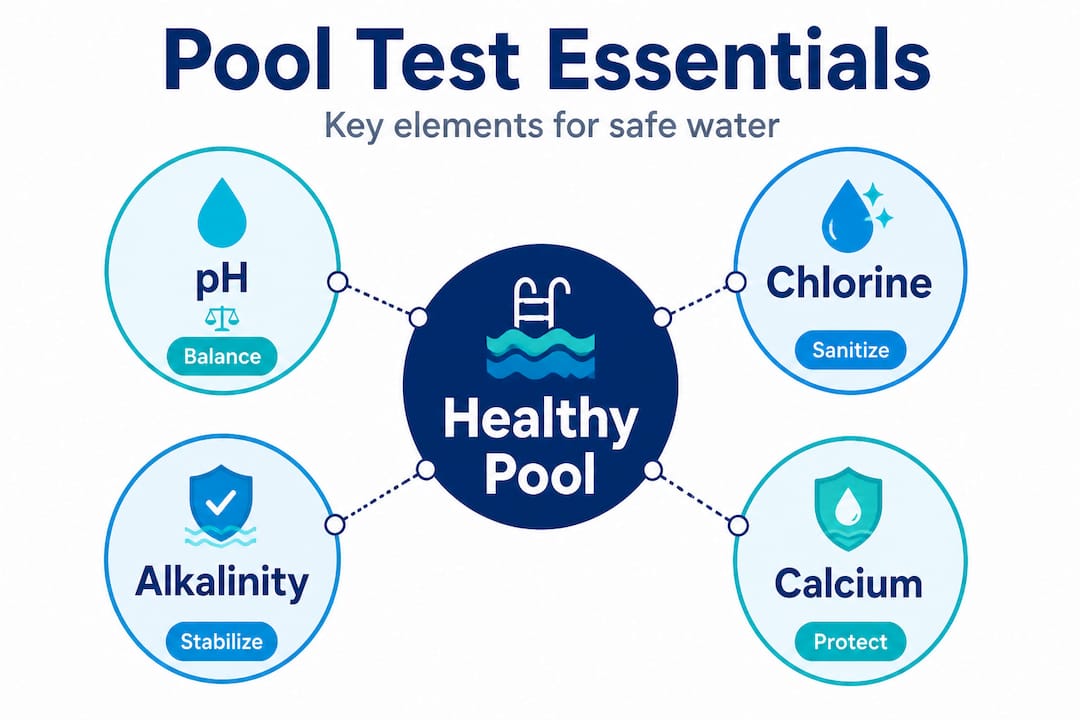
A complete water test measures several key parameters. Understanding what each one does helps you respond correctly when something looks off. Here is a quick reference table for the core elements and their target ranges:
| Parameter | Ideal range | Effect if too low | Effect if too high |
|---|---|---|---|
| pH | 7.2 to 7.8 | Corrosive water, eye irritation | Chlorine loss, cloudy water |
| Free chlorine | 1.0 to 3.0 ppm | Algae growth, bacteria risk | Bleaching, skin irritation |
| Total alkalinity | 80 to 120 ppm | pH swings, corrosion | Cloudy water, scale |
| Calcium hardness | 200 to 400 ppm | Etching, equipment damage | Scale buildup, rough surfaces |
| Cyanuric acid (stabilizer) | 30 to 50 ppm | Chlorine burns off quickly | Chlorine lockout |
Chemical balancing requires checking pH, chlorine, alkalinity, and more as part of a complete pool care routine. Each parameter does a specific job, and they all work together. For example, if your total alkalinity is too low, your pH will bounce around unpredictably no matter how much pH adjuster you add. Getting alkalinity right first makes everything else easier to manage.
Here is a step-by-step look at how to approach testing each element during swim season:
- Test free chlorine first. It changes fastest and directly affects swimmer safety. Check this at least twice a week during peak summer use.
- Check pH next. pH controls how well your chlorine actually works. Even a reading of 8.0 can cut chlorine effectiveness by more than half.
- Measure total alkalinity. Think of alkalinity as the buffer that keeps pH steady. Correct this before adjusting pH whenever possible.
- Test calcium hardness. This one moves slower, so weekly testing is usually enough. Protect your liner and equipment by keeping it in the 200 to 400 ppm range.
- Check cyanuric acid (stabilizer) monthly. This protects chlorine from UV breakdown. Too little means wasted chlorine; too much means the chlorine stops working effectively.
Most families should run a full check for signs of chemical imbalances at least once a week during the swimming season, and more often after heavy use, pool parties, or significant rainfall.
Common pool water testing methods compared
With an understanding of what you are testing for, let us look at the most popular water testing tools and how they compare.
| Testing method | Accuracy | Ease of use | Cost | Best for |
|---|---|---|---|---|
| Test strips | Moderate | Very easy | Low ($10 to $20) | Quick daily checks |
| Drop (DPD) kits | High | Moderate | Low to moderate ($20 to $50) | Weekly detailed testing |
| Digital testers | High | Easy | Higher ($50 to $200+) | Frequent, hands-off testing |
| Professional lab test | Very high | N/A (bring a sample) | Free to low cost | Seasonal deep checks |
Test strips are the most common starting point for families. You dip a strip into the water, wait a few seconds, and compare the color change to a chart. They are fast and inexpensive, which makes them great for quick daily checks. The tradeoff is that results can be harder to read accurately in bright sunlight, and some strips only test two or three parameters at once.
Drop (DPD) kits involve adding a set number of liquid or tablet reagents to a small water sample and counting drops or watching for a color change. These test kits should be accurate and convenient for routine use, and DPD kits deliver on that accuracy better than strips in most conditions. They take a few more minutes and a bit of practice, but many experienced pool owners prefer them for their reliability.
Digital testers use sensors to give you a precise numeric reading in seconds. They remove the guesswork from color comparison, making them ideal for anyone who wants quick and objective results. The upfront cost is higher, but if you are testing multiple times a week all season, the investment often pays off in both time and confidence.
Professional testing is in a category of its own. Professional testing uses systems like BioGuard’s ALEX and DPD kits, which measure a broader range of parameters with laboratory-grade precision. This level of testing is invaluable for troubleshooting persistent problems, confirming that your water is balanced at the start and end of each season, or getting a complete picture when home kits leave you with more questions than answers.
Pro Tip: Always collect your water sample from elbow depth in the middle of the pool, away from return jets and skimmers. Surface water gives inaccurate readings and can throw off your adjustments.
Knowing how to balance pool chemicals starts with knowing exactly what you are dealing with, and the right testing tool gets you there faster.
How to interpret results and respond to imbalances
Choosing the right testing method is just the start. Here is how to use your results to keep your pool comfortable and safe for everyone.
When your test comes back, the first step is comparing each reading to the target ranges listed in the table above. A single reading outside the ideal range does not always mean an emergency, but it does mean you need to act before the imbalance compounds. Here is what to watch for:
- Green or cloudy water usually points to algae growth from low chlorine or high pH.
- Strong chemical odor is often a sign of chloramines (used-up chlorine reacting with ammonia), not excess chlorine.
- Red, itchy eyes or skin irritation can signal pH that is too high or too low, or chloramine buildup.
- White or gray scale deposits on surfaces or equipment indicate high calcium hardness.
- Slippery or slimy surfaces suggest early algae growth from low sanitizer levels.
Proper action based on water testing prevents irritation, cloudy water, and algae before they become serious problems. When you identify an issue, here are the basic response steps:
- Low chlorine: Add granular or liquid chlorine and retest after four hours.
- High pH: Add a pH decreaser (sodium bisulfate or muriatic acid) according to your pool volume.
- Low alkalinity: Add sodium bicarbonate slowly over a day or two.
- High calcium hardness: Partial drain and refill with fresh water is usually the most effective fix.
- Low cyanuric acid: Add stabilizer granules directly to the skimmer with the pump running.
Pro Tip: Always adjust alkalinity before adjusting pH. Fixing alkalinity first makes pH adjustments far more stable and reduces the amount of product you need to use overall.
If you test, adjust, and retest but your water still will not cooperate after 24 to 48 hours, that is a strong signal to bring a water sample to a professional. Some issues, like combined chlorine buildup or phosphate levels that fuel algae, require balancing pool chemicals with products and techniques that go beyond basic home kits.
A local perspective: what most families miss about pool water testing
After learning the basics, here is a candid look at what Central Indiana pool owners often overlook, and our honest suggestions for better long-term pool health.
In our experience working with families across Indianapolis and the surrounding communities since 1981, we have seen one pattern repeat itself every summer: people wait until there is a visible problem before they test. The pool turns green, or someone complains about burning eyes, or a party is coming up and suddenly testing feels urgent. By that point, correcting the water takes more time, more product, and more money than it would have if testing had happened consistently throughout the season.
Here is what makes Central Indiana particularly challenging for pool owners. Our summers cycle between stretches of intense heat and heavy thunderstorm activity. A single storm can add hundreds of gallons of diluted, slightly acidic rainwater to your pool, dropping chlorine levels and destabilizing pH in hours. Then a stretch of 90-degree days burns off whatever chlorine remained. This pattern of dilution followed by intense UV exposure demands more frequent testing than you would need in a more stable climate.
Many families rely entirely on home test strips throughout the season, which works for routine monitoring, but it is not the full picture. Strips and basic drop kits do not test for phosphates, cyanuric acid buildup over time, or metals that can stain your liner. Getting a professional test at least once each season, ideally at the start when you open the pool and once more mid-season, fills in those gaps. The BioGuard ALEX water test insights we use at Pools of Fun give a far more detailed look at your water than any home kit can provide.
One more suggestion: make water testing part of your family’s weekly routine rather than a chore that gets pushed aside. Some families test on Sunday evenings so the pool is ready for the school week. Others test Saturday mornings before weekend swim time. When kids are involved, even just handing them the test strips to dip and compare, they start to understand pool care at a young age. It builds good habits and takes some of the responsibility off one person’s shoulders.
Dive deeper with Pools of Fun
Ready to put expert pool water testing into action? We are here to make it easy for every family in Central Indiana.
At Pools of Fun, we offer in-store water testing at all five of our retail locations across the Indianapolis area, and it is completely free. Just bring in a water sample and our certified staff will walk you through a detailed analysis using professional-grade testing systems. Whether your pool needs a simple adjustment or a more thorough chemical overhaul, we give you a clear action plan with the right products to get things back on track.
Beyond water testing, we are also your local resource for backyard upgrades, including custom in-ground pools, hot tubs, outdoor kitchens, and complete outdoor living spaces that make every swim season better than the last. Stop by any location or reach out online to schedule your free water test today.
Frequently asked questions
How often should I test my pool water?
You should test your pool water at least once a week, or more often after heavy swim use or storms. Weekly testing is recommended for both safety and consistent maintenance throughout swim season.
What should my pH and chlorine levels be?
Ideal pH falls between 7.2 and 7.8, and free chlorine should stay between 1 and 3 parts per million. These levels prevent irritation and keep your water clear and comfortable for swimmers.
Is a cloudy pool always unsafe?
Cloudy water often signals a chemical imbalance that needs attention, but not every cloudy pool poses an immediate health risk if you correct it quickly. That said, cloudiness signals chemical imbalance that should never be ignored or left unaddressed.
Can I bring a pool water sample for professional testing?
Yes, Pools of Fun offers professional in-store water testing at all five Central Indiana locations, and it is free of charge for local families.
Does rain affect my pool water chemistry?
Yes, rainwater dilutes chemicals and can lower both chlorine levels and pH significantly. Testing after storms is especially important in Central Indiana, where summer storm activity is frequent and unpredictable.
Recommended
- The Back Yard Chemist: Balancing Your Pool’s pH and Chlorine – Pools of Fun
- Pool Maintenance Guide – Pools of Fun
- Everything You Need To Know About Bioguard’s ALEX Water Tests Utilized at Pools of Fun – Pools of Fun
- Signs of Off-Balance Pool Chemicals
- Expert Summer Pool Preparation Tips For Florida Homeowners