TL;DR:
- Sand filters are affordable, easy to maintain, but filter larger particles and require regular backwashing.
- Cartridge filters offer better water clarity, lower maintenance, and operate at lower pressure, with no backwashing needed.
- DE filters provide the finest filtration, ideal for heavy debris or pollen, but require more maintenance and higher initial costs.
Choosing the right pool filter is one of the most consequential decisions you’ll make for your new or upgraded pool. Get it right, and water stays sparkling with minimal effort. Get it wrong, and you could be spending extra hours on maintenance, dealing with cloudy water, or replacing equipment far sooner than expected. With sand, cartridge, and diatomaceous earth (DE) filters each offering a distinct approach, the options can feel overwhelming. This guide breaks down everything you need to know, compares all three types side by side, and points you toward the choice that fits your backyard, your schedule, and your Central Indiana environment.
Table of Contents
- Key factors to consider when choosing a pool filter
- Sand filters: Affordable and easy to use
- Cartridge filters: Low-maintenance and efficient
- Diatomaceous earth (DE) filters: Best for crystal-clear water
- Side-by-side comparison of pool filter types
- Pool expert perspective: Making the right filter choice for Indiana homes
- Get expert guidance and seamless pool filter installation
- Frequently asked questions
Key Takeaways
| Point | Details |
|---|---|
| Choose by needs | Select your pool filter type based on water quality goals, maintenance preference, and budget. |
| Sand filters | Sand filters offer affordability and simple operation for most average pools. |
| Cartridge filters | Cartridge filters need less frequent cleaning and save on water, making them ideal for lower-maintenance setups. |
| DE filters | DE filters provide the clearest water but require more work and ongoing cost. |
| Professional advice helps | Consulting a pool professional ensures you get the best filter for your specific needs and location. |
Key factors to consider when choosing a pool filter
Before comparing specific filter types, it helps to establish the criteria that actually matter for your situation. Filter selection impacts maintenance effort and long-term pool performance, so this is not a decision to make on price alone.
Here are the most important factors to weigh:
- Pool size and volume. Larger pools need higher-capacity filters that can turn over water efficiently. Undersizing a filter is one of the most common mistakes homeowners make.
- Local water quality and debris sources. Central Indiana pools deal with spring pollen, falling leaves, grass clippings, and occasionally clay-heavy soil from runoff. Your debris environment should guide your filtration strength.
- Maintenance preference. Some filters need weekly attention; others can go months between service. Be honest with yourself about how much hands-on time you want to commit.
- Upfront cost vs. long-term operating cost. A cheaper filter may cost more over time through water waste, chemical use, or frequent part replacement.
- Replacement part availability and local service support. If parts are hard to source or technicians unfamiliar with your filter type, that creates problems down the road.
Taking time to review a comprehensive pool buying guide can help you frame these decisions in the broader context of your pool installation, so you’re not making filter choices in isolation.
Pro Tip: Sketch out a quick priority list before you shop. Rank maintenance time, budget, and water clarity in order of importance to you. Your ranking will point you toward one filter type almost immediately.
With selection criteria in mind, let’s dive into the main pool filter types you’ll encounter.
Sand filters: Affordable and easy to use
Sand filters are the most widely installed filter type in residential pools, and for good reason. They are straightforward, durable, and affordable, making them a practical starting point for most homeowners.
Here is how they work: water from your pool is pumped through a tank filled with specially graded filter sand. As water passes through, debris and contaminants get trapped between the sand particles. Filtered water flows back into the pool. Over time, the trapped debris builds up and restricts flow, which is when backwashing becomes necessary.
Backwashing reverses the flow of water through the sand bed, flushing debris out through a waste line. It typically takes about two minutes and should be done when the pressure gauge reads 8 to 10 psi above the normal starting pressure.
Key characteristics of sand filters:
- Filtration range: Captures particles down to about 20 to 40 microns in size
- Maintenance cycle: Backwash every 1 to 4 weeks depending on pool usage and debris load
- Lifespan: Sand lasts between 5 to 7 years before needing replacement
- Best for: Medium to large pools with moderate debris and owners who prefer simple, routine maintenance
- Cost range: Generally the lowest upfront cost of the three filter types
Sand filters are reliable and generally easier to maintain, but need periodic backwashing to stay effective. The process is quick, but it does use water each time, which is worth factoring in if you’re on a metered supply.
One thing to keep in mind is that sand filters have the widest filtration range of the three types, meaning they let smaller particles through. Very fine debris like pollen, algae spores, or sunscreen residue can pass through a sand filter and remain in your pool water. For many Indiana homeowners, this is a manageable tradeoff given the lower cost and simplicity.
You can learn about sand filter systems in more detail, including the specific sand grades and installation considerations that matter for your pool setup. When installed with the right pump and heavy-duty construction components, sand filters deliver reliable performance for years.
Pro Tip: Consider switching from standard filter sand to a zeolite or glass filter media. These materials filter finer particles than regular sand and can extend the time between backwashes, giving you some of the benefits of a higher-grade filter without changing your entire system.
Understanding sand filters is a great starting point, but they’re just one option. Next, explore another popular choice: cartridge filters.
Cartridge filters: Low-maintenance and efficient
Cartridge filters have grown steadily in popularity among homeowners who want strong performance without the hassle of regular backwashing. If you value a cleaner weekend schedule, this filter type deserves serious consideration.
Instead of sand, cartridge filters use a pleated polyester fabric element housed inside a canister. Water flows through the pleated surface, and debris is captured on the fabric. The large surface area created by the pleating allows these filters to trap fine particles efficiently while maintaining good flow rates even as debris accumulates.
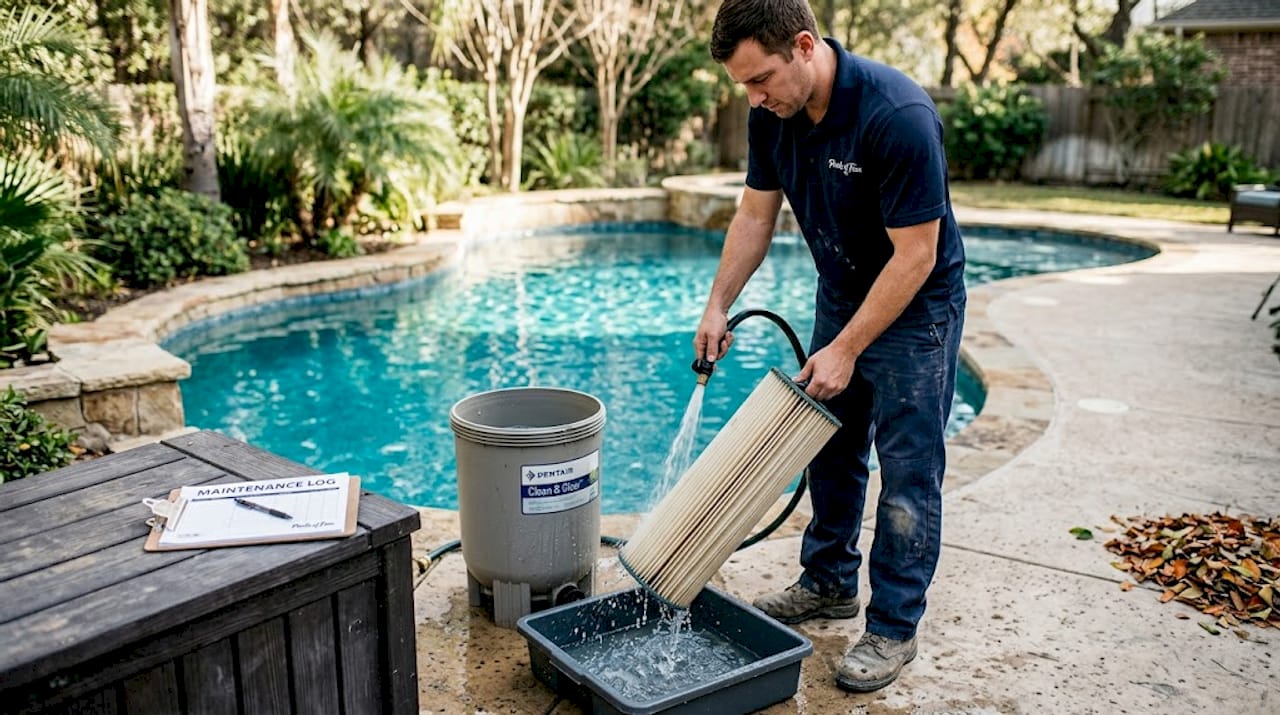
Cartridge filters capture smaller particles and demand less frequent maintenance than sand filters. They filter down to approximately 10 to 15 microns, which means noticeably clearer water compared to standard sand filtration.
Key characteristics of cartridge filters:
- Filtration range: Captures particles down to 10 to 15 microns
- Maintenance cycle: Remove and rinse the cartridge every 4 to 6 weeks; deep clean with cartridge cleaner solution 1 to 2 times per season
- Lifespan: Cartridges typically last 2 to 5 years before replacement is needed
- Best for: Homeowners who want low-maintenance operation and above-average water clarity
- Water usage: No backwashing required, which saves water compared to sand filters
Here is a quick comparison of sand and cartridge filters on a few key points:
| Feature | Sand filter | Cartridge filter |
|---|---|---|
| Filtration (microns) | 20 to 40 | 10 to 15 |
| Backwashing needed | Yes | No |
| Maintenance frequency | Every 1 to 4 weeks | Every 4 to 6 weeks |
| Upfront cost | Low | Moderate |
| Water waste | Moderate | Minimal |
| Operating pressure | Higher | Lower |
The lower operating pressure of cartridge filters is an important practical benefit. When a filter runs at lower pressure, your pump works less hard, which often translates to reduced energy consumption over the course of a season. For Indiana homeowners running their pool pumps through a long summer, that efficiency adds up.
Detailed filter maintenance tips can help you stay on track with a cartridge cleaning schedule throughout the season.
Pro Tip: When you remove a cartridge for cleaning, let it soak overnight in a dedicated cartridge cleaner solution rather than just rinsing it. This breaks down oils and sunscreen buildup that water alone cannot remove, extending the life of the cartridge significantly.
Cartridge filters offer minimal fuss, but for those seeking top-tier water clarity, there’s a third category to consider: diatomaceous earth (DE) filters.
Diatomaceous earth (DE) filters: Best for crystal-clear water
If you want the clearest pool water possible and you’re willing to commit to more involved maintenance, DE filters are the top performer of the three types. They are especially well suited to Indiana pools surrounded by mature trees, flower beds, or any environment that generates fine debris.
DE stands for diatomaceous earth, a naturally occurring powdered material made from the fossilized remains of tiny aquatic organisms called diatoms. This powder is coated onto internal filter grids inside the DE filter housing. When pool water passes through, the DE powder traps particles at an extremely fine level.
DE filters deliver the highest filtration quality, removing very fine particles down to 2 to 5 microns in size. To put that in perspective, a human hair is roughly 70 microns wide. DE filters remove particles far too small to see with the naked eye, including fine pollen grains, which are a real issue for Central Indiana pools during spring and early summer.
Key characteristics of DE filters:
- Filtration range: Captures particles down to 2 to 5 microns, the finest of any residential filter type
- Maintenance cycle: Requires backwashing and recharging with fresh DE powder after each backwash cycle
- Lifespan: Internal filter grids last 5 to 10 years with proper care; DE powder is added seasonally
- Best for: Pools with heavy fine debris, allergy-conscious families, or homeowners who prioritize water appearance above all else
- Cost range: Highest upfront cost and ongoing powder cost, but outstanding performance in return
One important detail: after you backwash a DE filter, the DE powder is flushed out along with the debris. You have to reload the filter with fresh DE powder through the skimmer. This adds a step that sand and cartridge filters do not require. Handling DE powder also calls for a dust mask, since it is a fine particulate material that should not be inhaled.
Pools near wooded areas or with lots of surrounding landscaping will see the biggest benefit from efficient filtration systems like DE, where superior particle capture keeps water from turning hazy during high-debris periods.
Pro Tip: Never backwash a DE filter into your lawn or landscaping beds. DE powder is a pest and weed deterrent in garden settings, but in concentrated quantities it can be harmful to plants and soil biology. Always direct backwash water to an appropriate waste line or drainage area.
Now that all three filter types are clear, let’s see how they stack up side by side.
Side-by-side comparison of pool filter types
Each filter type has key advantages and drawbacks depending on your priorities and pool conditions. This full comparison helps you make a clear decision.
| Feature | Sand | Cartridge | DE |
|---|---|---|---|
| Filtration level | 20 to 40 microns | 10 to 15 microns | 2 to 5 microns |
| Water clarity | Good | Very good | Excellent |
| Backwashing | Required | Not required | Required + recharge |
| Maintenance effort | Low to moderate | Low | Moderate to high |
| Upfront cost | $ | $$ | $$$ |
| Energy efficiency | Moderate | High | Moderate |
| Lifespan | 5 to 7 years (sand) | 2 to 5 years (cartridge) | 5 to 10 years (grids) |
To narrow down your best fit, work through this quick decision checklist:
- Is your pool under 20,000 gallons with moderate debris? A sand filter offers reliable, budget-friendly coverage.
- Do you want to minimize weekend maintenance tasks? A cartridge filter delivers strong filtration with the fewest interruptions.
- Is crystal-clear water a top priority, or do you have heavy seasonal debris? A DE filter provides the finest filtration available.
- Are you concerned about water bills or water conservation? Cartridge filters use the least water since they skip backwashing.
- Do you want access to advanced filtration options? Reviewing specialty systems can reveal configurations that pair well with any of the three filter types.
If you still have questions about installation logistics, reviewing installation frequently asked questions covers what to expect during the setup phase.
Having compared filter types directly, it’s time for expert perspective on how to balance tradeoffs for your specific situation.
Pool expert perspective: Making the right filter choice for Indiana homes
After decades of working with Central Indiana homeowners, we’ve noticed a consistent pattern: the filter that looks best on paper isn’t always the filter that serves a given household best in practice.
Here’s the honest reality. Indiana spring and early summer bring heavy pollen loads, particularly in neighborhoods with older trees and established landscaping. That pollen gets into pools fast and can turn water hazy within a day or two during peak bloom. In those situations, DE filtration provides a real, visible benefit. But most homeowners aren’t running their pools hard in April. By the time July and August arrive and the pool sees heavy daily use, the pollen has settled and the primary debris shifts to sunscreen, body oils, and grass clippings. That is a different filtration challenge entirely.
What this means practically is that no single filter type is universally superior for every Indiana yard. The best choice depends on when you use your pool most, what grows around it, and how much time you’re genuinely willing to spend on maintenance. We’ve seen homeowners invest in DE systems because they wanted perfect water clarity, only to find that the extra maintenance steps felt like a burden by mid-season.
Our honest recommendation for most Central Indiana families is the cartridge filter. It handles the majority of debris situations well, saves water, and demands far less routine attention than the alternatives. If your yard is heavily wooded or you have severe seasonal pollen and debris, that’s when a DE filter earns its higher price.
We also want to emphasize something that filter comparison guides often overlook: local service support matters as much as technical specifications. A filter with great filtration ratings means little if your service team isn’t familiar with it. Understanding pool maintenance after installation is just as important as the initial equipment choice, and professional consultation can surface factors specific to your yard, water chemistry, and usage patterns that no online guide can fully anticipate.
Get expert guidance and seamless pool filter installation
Selecting and installing the right pool filter is much easier when you have an experienced team in your corner from the start. Pools of Fun has been serving Central Indiana homeowners since 1981, and our team understands the specific debris, weather, and water quality conditions that affect pools across the Indianapolis area.
Browse our completed pool projects to see how we’ve designed and built pools across a wide range of backyards and budgets. When you’re ready to understand why local expertise makes a real difference in equipment selection, installation quality, and long-term performance, our page on reasons to choose Pools of Fun explains exactly what sets our process apart. You can also get quick answers to common setup questions through our installation FAQs. Reach out to our team for a free consultation, and let’s make sure your pool filter is the right fit from day one.
Frequently asked questions
How often should I replace sand in my pool filter?
Sand typically needs replacement every 5 to 7 years, or sooner if water clarity declines despite regular backwashing.
Which pool filter is best for removing fine Indiana pollen?
DE filters are the best option, since DE filters remove the finest particles including pollen down to 2 to 5 microns in size.
Do cartridge filters require backwashing?
No. Cartridge filters do not require backwashing; instead, you simply remove the cartridge and rinse or soak it to restore performance.
Can I switch filter types after my pool is built?
Yes, but system upgrades may require plumbing adjustments and should be handled by a qualified pool technician to ensure compatibility with your existing pump and circulation system.
What filter type is most energy efficient?
Cartridge filters are typically the most energy efficient because they operate at lower pressure, reducing the workload on your pump and lowering energy consumption over the course of a season.