TL;DR:
- Regularly test and adjust water chemistry to ensure safety and effectiveness.
- Consistent cleaning, equipment checks, and seasonal preparations prevent costly repairs and issues.
- Maintaining proper balance and routine helps keep pools safe, clean, and enjoyable year-round.
Most new pool owners assume that as long as the water looks clear and blue, everything is fine. That’s one of the most common and costly misconceptions we see. Real pool maintenance covers far more than skimming leaves off the surface or adding a splash of chlorine. It’s a system of regular tasks that protect your water quality, safeguard your family’s health, extend the life of your equipment, and ensure your pool is ready to enjoy from Memorial Day through Labor Day. This guide breaks down exactly what pool maintenance involves, how to build a routine that works for your life in Central Indiana, and how to troubleshoot problems before they become expensive repairs.
Table of Contents
- What pool maintenance really means
- Key elements of effective pool maintenance
- How to build a simple pool maintenance routine
- Troubleshooting common pool maintenance issues
- Our take: Pool maintenance is less about perfection and more about consistency
- Get support for your pool maintenance journey
- Frequently asked questions
Key Takeaways
| Point | Details |
|---|---|
| Routine is key | Simple, consistent pool care is far more effective than rarely performed deep cleans. |
| Water chemistry matters | Maintaining the right chemical balance keeps your pool safe and extends its life. |
| Address issues early | Spotting and fixing small problems prevents costly repairs and more downtime. |
| Adapt for Indiana seasons | Pool care routines should adjust with Central Indiana’s unique seasonal needs. |
What pool maintenance really means
Let’s clear up a widespread misconception: crystal-clear water does not always mean safe water. A pool can look perfectly inviting while hiding dangerously imbalanced chemistry. That’s why pool maintenance covers water chemistry, cleanliness, and equipment care, all working together as one system.
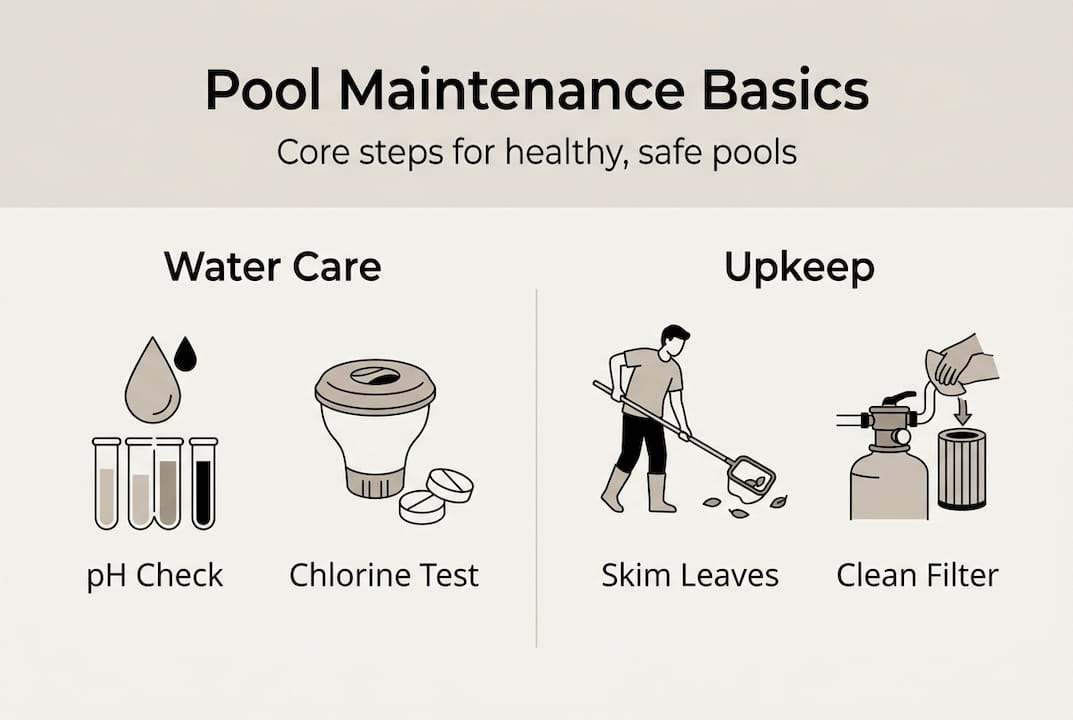
Pool maintenance is the ongoing practice of keeping your water chemically balanced, your surfaces clean, and your mechanical systems functioning properly. Skip one area, and the others start to suffer. Ignore water chemistry, and you risk algae, skin irritation, and corroded equipment. Neglect cleaning, and debris clogs your filter and reduces circulation. Let equipment go uninspected, and a small pump issue can turn into a full replacement bill.
In Central Indiana, pool care has a seasonal dimension that owners in warmer states don’t deal with. Our winters require proper pool closing and winterization, and our summers can bring heavy rain, high humidity, and rapid temperature shifts that push water chemistry out of balance faster than you’d expect. Understanding the basics of pool maintenance for a climate like ours means thinking year-round, not just during swim season.
Here are the most common myths we hear from new pool owners:
- “Clear water is safe water.” Chemistry is invisible. Test it regardless of how the water looks.
- “I only need to add chemicals after a big swim party.” Chemical demand builds gradually. Weekly testing catches imbalances early.
- “Chlorine does all the work.” Chlorine works best within a specific pH range. Without balance, it loses effectiveness fast.
- “Pool maintenance is too complicated.” It isn’t, once you understand the rhythm. Reviewing common pool mistakes is a great way to accelerate your learning curve.
The benefits of proper maintenance go well beyond a pretty pool. You protect swimmers from waterborne illness, avoid costly equipment repairs, and maximize your investment in a backyard space your family will use for years.
“A well-maintained pool doesn’t happen by accident. It happens because the owner understands that chemistry, cleanliness, and equipment all work as one system.”
Pro Tip: Bookmark the maintenance FAQs page for quick answers when something looks off. Having a reference point saves time and guesswork.
Key elements of effective pool maintenance
Now that you understand the big picture, let’s break down the specific components that make up a complete maintenance plan.
Water chemistry
This is the foundation of everything. Key water chemistry targets are: pH 7.2 to 7.8, chlorine 1 to 3 ppm, total alkalinity 80 to 120 ppm, calcium hardness 200 to 400 ppm, and cyanuric acid 30 to 50 ppm. These numbers aren’t arbitrary. Each one affects the others, and together they determine whether your water is safe, comfortable, and protected.
| Parameter | Ideal Range | Why it matters |
|---|---|---|
| pH | 7.2 to 7.8 | Keeps chlorine effective and prevents eye irritation |
| Chlorine | 1 to 3 ppm | Kills bacteria and prevents algae |
| Total alkalinity | 80 to 120 ppm | Stabilizes pH from swinging |
| Calcium hardness | 200 to 400 ppm | Prevents surface etching or scaling |
| Cyanuric acid | 30 to 50 ppm | Protects chlorine from UV breakdown |
Learning about balancing pool chemicals and understanding pool pH and chlorine levels will give you confidence every time you test.
Cleaning tasks
Chemistry alone won’t keep your pool healthy. Physical cleaning removes the debris and buildup that chemicals can’t handle on their own.
- Skim the surface daily to remove leaves, insects, and floating debris before they sink and decompose.
- Brush pool walls and floor weekly to prevent algae from taking hold on surfaces.
- Vacuum weekly using a manual or automatic cleaner to remove settled debris.
- Clean the filter according to your filter type, which includes backwashing a sand or DE filter and rinsing a cartridge filter.
Equipment inspection
Your pump, filter, heater, and automatic cleaner are the mechanical backbone of your pool. Check them monthly for unusual sounds, leaks, or reduced performance. Catching a small seal leak early costs far less than replacing a pump motor.
Pro Tip: Start with pool care for beginners if you’re in your first season. It simplifies the learning process and helps you prioritize what to check first.
How to build a simple pool maintenance routine
Knowing what to do is one thing. Doing it consistently is another. The key is breaking your maintenance tasks into manageable time blocks so nothing slips through the cracks.
Regular testing and cleaning, plus scheduled equipment checks, are what separate a healthy pool from a problem pool. Here’s how to organize those tasks:
Daily tasks
- Check water level and skim the surface
- Run the pump for 8 to 12 hours
- Quickly scan for visible issues like cloudy water or debris buildup
Weekly tasks
- Test water chemistry and adjust as needed
- Brush pool walls, steps, and floor
- Vacuum the pool
- Clean out the skimmer and pump baskets
Monthly tasks
- Inspect equipment for leaks, unusual noise, or worn parts
- Check and clean the filter
- Review chemical usage and restock supplies
Seasonal tasks
| Season | Priority tasks |
|---|---|
| Spring opening | Inspect equipment, balance chemistry, remove cover |
| Summer | Increase testing frequency during heat and heavy use |
| Fall | Reduce chemical use, begin closing preparations |
| Winter | Proper winterization to protect plumbing and equipment |
For Central Indiana pool owners, the seasonal transitions deserve extra attention. Indiana winters can damage unprotected plumbing and equipment. Following winter pool tips before the first freeze protects your investment and makes spring opening much smoother.
The fastest way to fall behind on maintenance is to avoid pool care errors that compound over time, like skipping weekly tests during a busy period or waiting too long to address cloudy water.
Troubleshooting common pool maintenance issues
Even when you follow your routine closely, problems can still appear. The good news is that most common pool issues have clear warning signs and straightforward solutions, especially when you catch them early.
Balanced water chemistry is the foundation for preventing cloudy water, algae, and equipment issues. When chemistry drifts out of range, you’ll usually see it before it becomes a crisis.
Here are the most common problems and what to look for:
- Cloudy water: Often caused by low chlorine, poor filtration, or high pH. Test chemistry first, then check your filter’s run time and condition.
- Green or black algae: A sign that chlorine dropped too low or circulation was poor. Shock the pool and brush walls aggressively. Algae on pool surfaces can take hold within 24 hours of a chlorine lapse.
- Strong chlorine smell: Counterintuitively, this smell usually means not enough chlorine. It’s caused by chloramines, which form when chlorine bonds with contaminants. Shock the pool to break them up.
- Equipment leaks: Look for wet spots around the pump, filter, or heater connections. Address leaks immediately to avoid water loss and motor damage.
- High or low chemical readings: Don’t guess. Use a reliable test kit or visit a local Pools of Fun location for free water testing. A precise reading leads to a precise fix.
For newer owners, visiting beginner pool troubleshooting gives you a structured approach when you’re not sure what’s wrong. And when in doubt, checking the pool owner FAQs can help you decide whether to handle it yourself or call a professional.
When to call a pro: If cloudy water doesn’t clear within 48 hours of adjusting chemistry, or if equipment is leaking and you can’t identify the source, it’s time to get expert eyes on the problem. Waiting rarely saves money.
Getting ahead of issues is always cheaper than reacting to them. A $10 bottle of shock used at the first sign of algae beats a $200 algaecide treatment applied after a full bloom takes over.
Our take: Pool maintenance is less about perfection and more about consistency
Here’s something most instruction manuals won’t tell you: the homeowners who struggle most with pool maintenance aren’t the ones who know the least. They’re the ones who try to do everything perfectly and then give up when life gets busy.
We’ve worked with pool owners across Central Indiana since 1981, and the pattern is consistent. The pools that look great in August aren’t the ones with the most complicated treatment plans. They belong to owners who test twice a week, brush when they notice buildup, and pay attention to seasonal shifts. Nothing more.
Indiana’s climate adds a specific wrinkle. Our spring can arrive and leave within the same week, and our summer storms can dump enough rain to dilute your chemicals overnight. That’s why understanding pool maintenance basics for this region matters more than following a generic national guide.
Simplify your approach. Pick a testing day and stick to it. Let consistency do the heavy lifting, and pool care stops feeling like a burden.
Get support for your pool maintenance journey
If you want pool care to feel less like a chore and more like a simple habit, you don’t have to figure it all out alone. Pools of Fun has been helping Central Indiana homeowners build and maintain beautiful pools for over 40 years, and we’re ready to help you too.
Start by exploring everything you need to learn more about pool maintenance in one place. If you’re thinking about a renovation or curious what’s possible, browse our pool project examples for inspiration. And if your backyard is ready for more than just a pool, see how we can help you upgrade your outdoor living with patios, outdoor kitchens, and more. Stop in at any of our five Central Indiana locations for free water testing and personalized advice from our certified team.
Frequently asked questions
How often should I check my pool’s water chemistry?
Test pool water 2 to 3 times per week during the swim season, and more often after heavy rain, extreme heat, or high swimmer activity. Consistent testing catches imbalances before they become visible problems.
What’s the ideal pH and chlorine range for a home pool?
Maintain your pool’s pH between 7.2 and 7.8 and keep chlorine between 1 and 3 ppm. These ranges ensure effective sanitation and comfortable swimming for your family.
What are signs my pool needs immediate attention?
Cloudy water, green or black discoloration, a strong chemical smell, or foamy water all signal that something is off. Balanced chemistry prevents most of these issues, so address any visible warning sign quickly.
Is pool maintenance different for Central Indiana?
Yes. Indiana’s four-season climate requires year-round attention, with a strong focus on proper winterization in the fall and chemistry management during hot, rainy summers. A generic maintenance routine won’t account for those regional demands.