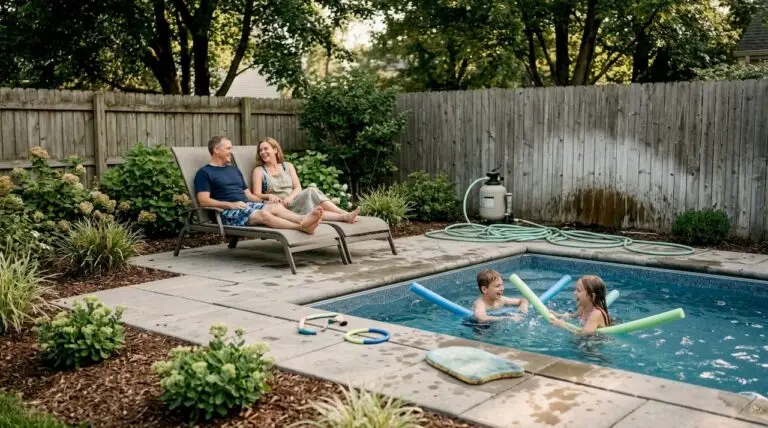
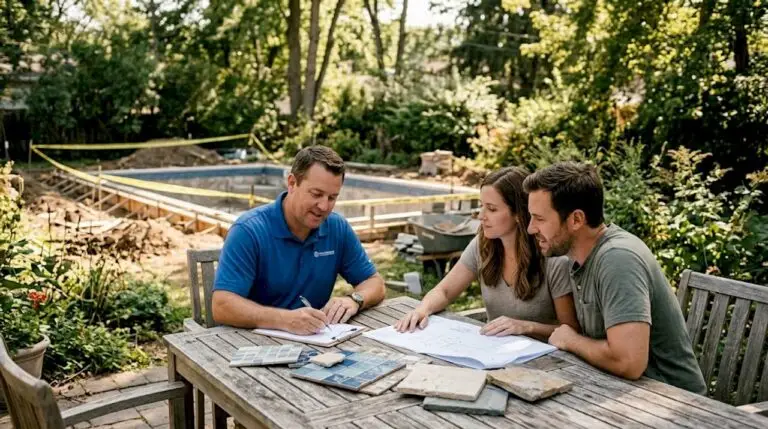
Not all in-ground pools demand months of construction chaos or a weekend chemistry lab to stay clean. Many Central Indiana homeowners still assume that going in-ground means going all-in on maintenance, cost, and disruption. Fiberglass pools challenge that assumption directly. As a pre-manufactured, one-piece swimming pool shell made from layers of fiberglass-reinforced plastic and resin with a smooth, non-porous gelcoat surface, fiberglass pools offer a faster, lower-maintenance path to backyard enjoyment. This guide covers what fiberglass pools are, how they are built and installed, why they suit Indiana’s climate, and what the real trade-offs look like before you invest.
Table of Contents
- What is a fiberglass pool and how is it made?
- How fiberglass pools are installed: Speed, process, and local expertise
- Benefits of fiberglass pools for Indiana homeowners
- Potential drawbacks and limitations
- Cold climate, winter care, and Indiana soil: What to know
- Our perspective: The real calculus for Indiana fiberglass pools
- Ready for a fiberglass pool transformation?
- Frequently asked questions
Key Takeaways
| Point | Details |
|---|---|
| One-piece construction | Fiberglass pools are made as a single, factory-molded shell for long-term durability. |
| Fast, low-disruption install | Most fiberglass pools are fully installed in just 2 to 6 weeks with minimal mess. |
| Low maintenance needs | Non-porous surfaces mean fewer chemicals, less algae, and no resurfacing required. |
| Indiana climate ready | Properly installed fiberglass pools flex to handle frost and clay soils common in Central Indiana. |
| Custom features possible | While shape options are set by molds, built-in benches, steps, and water features are available. |
What is a fiberglass pool and how is it made?
A fiberglass pool is not assembled on your property like a concrete pool. It arrives as a finished shell, manufactured in a controlled factory environment using precision molds. Understanding how it is made helps explain why it performs so well over time.
Fiberglass pools are factory-molded using precision molds with layers of gelcoat, vinyl ester resin, fiberglass reinforcement, and structural resins applied in a controlled environment. Each layer serves a specific purpose:
- Gelcoat (outer layer): A smooth, non-porous finish that resists algae, staining, and chemical absorption
- Vinyl ester resin: Provides a moisture barrier and protects the structural layers from water intrusion
- Fiberglass reinforcement: Woven glass fibers that give the shell its strength and flexibility
- Structural resin layers: Bond everything together and provide rigidity under load
The non-porous gelcoat is particularly important. Because it does not absorb water, algae cannot take root the way it can in porous concrete. That directly reduces your chemical usage and cleaning time.
Factory production also means consistent quality. Every shell is built under the same conditions, with the same materials, and inspected before it leaves the facility. You are not depending on field conditions or crew variability the way you would with a poured concrete pool.
| Layer | Material | Function |
|---|---|---|
| Outer surface | Gelcoat | Smooth, non-porous finish |
| Moisture barrier | Vinyl ester resin | Prevents water intrusion |
| Structural core | Fiberglass reinforcement | Strength and flexibility |
| Bonding layer | Structural resin | Rigidity and cohesion |
To understand how this translates into your actual backyard project, review the fiberglass construction process in detail.
Pro Tip: Always ask your pool builder for the manufacturer warranty and the specific resin and gelcoat specifications. A quality shell uses vinyl ester resin, not polyester, which is far more resistant to water absorption and osmotic blistering over time.
How fiberglass pools are installed: Speed, process, and local expertise
With a grasp of how the pool shell is made, it is important to understand how fiberglass pools actually go from delivery to swim-ready in your backyard.
One of the most compelling advantages of fiberglass is speed. Installation involves excavating a precise hole, crane-placing the shell, backfilling with gravel or crushed stone, plumbing, electrical setup, and equipment installation, typically completing in 2-6 weeks. Compare that to a concrete pool, which can take two to three months from dig to first swim.
Here is how the process unfolds step by step:
- Site evaluation and permits: Your installer assesses soil conditions, drainage, and utility lines, then pulls the required permits.
- Excavation: A precise hole is dug to match the shell dimensions, accounting for backfill material around the sides.
- Shell delivery and crane placement: The one-piece shell is transported by truck and lowered into the excavation using a crane.
- Backfilling: Crushed stone or gravel is packed around the shell to provide drainage and structural support.
- Plumbing and electrical: Lines are run from the shell to the equipment pad, including filtration, heating, and lighting systems.
- Decking and finishing: Coping, patio, and any additional features are completed around the pool.
Fiberglass pools are typically swim-ready in 2 to 6 weeks, compared to 2 to 3 months for a concrete pool.
In Central Indiana, local expertise is not optional. Indiana’s clay-heavy soils and seasonal freeze-thaw cycles create specific challenges that a national installer unfamiliar with the region may not anticipate. Improper backfill in clay soil can trap water and cause the shell to shift. An experienced local crew knows how to see the full construction process through with the right drainage strategy from day one.
Pro Tip: Ask your installer specifically how they handle backfill in clay soil. The answer tells you a lot about their local experience and whether they will protect your investment long-term.
Benefits of fiberglass pools for Indiana homeowners
Understanding how fiberglass pools are installed leads directly into why so many Central Indiana families choose this pool type. Let’s explore the key benefits.
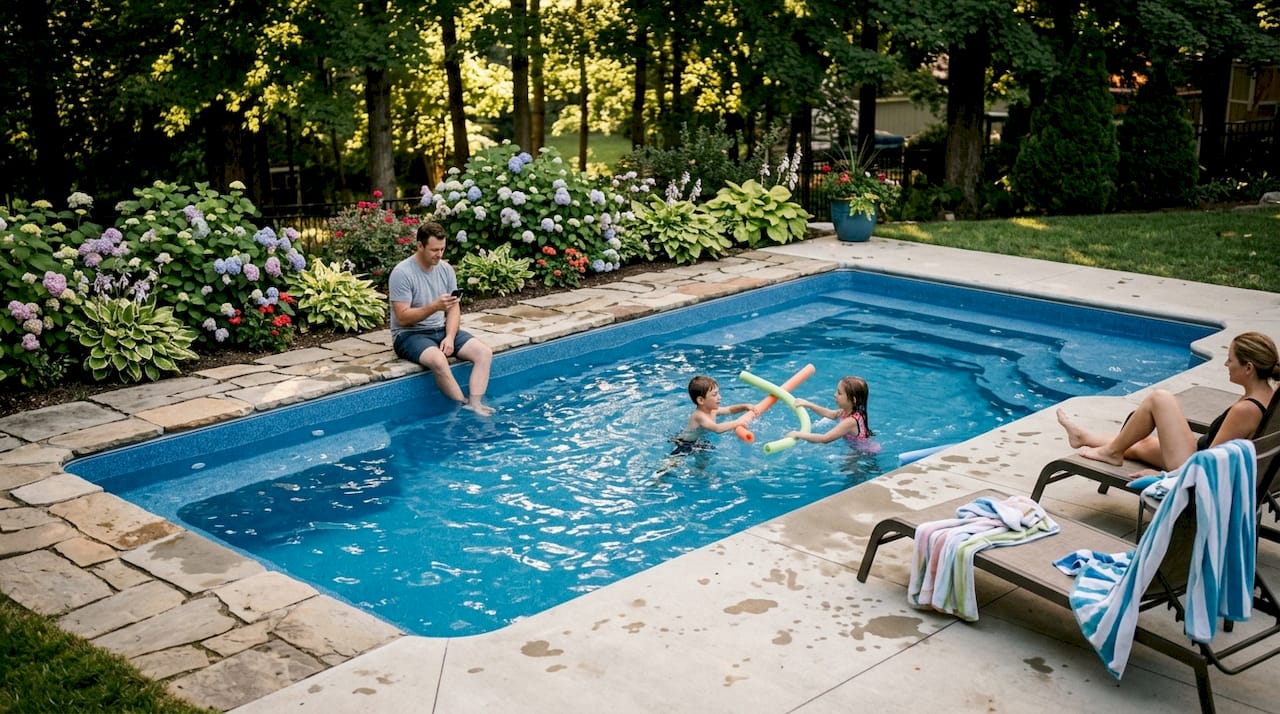
Key benefits include low maintenance due to non-porous surface resisting algae, fewer chemicals, no resurfacing, quick install, energy efficiency from insulation, smooth feel, and durability of 25-50+ years. For Indiana families who want a backyard oasis without constant upkeep, those advantages are significant.
Here is what that looks like in practice:
- Lower chemical costs: 30-40% lower chemical costs compared to concrete pools, because the gelcoat surface does not absorb chemicals or harbor algae
- No resurfacing: Concrete pools typically need resurfacing every 10-15 years. Fiberglass shells do not.
- Smooth comfort: The gelcoat surface is gentle on feet and skin, unlike rough concrete
- Built-in insulation: Fiberglass retains heat better than concrete, which can lower your heating costs over a full season
- Resale value: Pool investments typically return 65-78% of their cost in home value, making fiberglass a strong long-term asset
| Feature | Fiberglass | Vinyl liner | Concrete |
|---|---|---|---|
| Lifespan | 30-50+ years | 10-15 years (liner) | 25-50 years |
| Install time | 2-6 weeks | 2-4 weeks | 2-3 months |
| Chemical costs | Low | Medium | High |
| Resurfacing needed | No | Liner replacement | Yes, every 10-15 years |
| Surface comfort | Smooth | Smooth | Rough |
Explore the full list of fiberglass pool advantages or compare all pool types to see how they stack up for your specific backyard goals.
Pro Tip: Opt for built-in benches, tanning ledges, and steps during the initial design phase. These features are molded directly into the shell and will last as long as the pool itself, with no additional maintenance.
Potential drawbacks and limitations
As attractive as fiberglass pools are for maintenance and lifespan, they are not perfect. Here are the most important drawbacks to consider before you commit.
Limitations include restricted customization to manufacturer molds, with shapes and sizes typically up to about 16 by 40 feet for transport, and a higher upfront cost compared to vinyl liner pools. If you have a very specific shape in mind or a uniquely sized yard, those mold restrictions may matter.
Here are the key limitations to weigh:
- Size and shape restrictions: You are choosing from available molds, not designing from scratch like you can with concrete
- Higher upfront cost: Fiberglass typically costs more than vinyl liner at the point of purchase, though long-term savings often offset this
- Gelcoat aging: After 15 or more years, the gelcoat surface can fade or develop minor cracks, requiring professional refinishing
- Shell shift risk: Risk of shell shift from poor backfill or groundwater issues, and gelcoat fading after 15+ years, are real concerns when installation is not done correctly
- Clay soil challenges: Indiana’s clay-heavy ground requires careful drainage planning to avoid hydrostatic pressure on the shell
“Most fiberglass pool problems we hear about trace back to installation shortcuts, not the shell itself. In Indiana’s clay soils, a pool set without proper crushed stone backfill and drainage planning is a pool set up for problems down the road.”
Reviewing pool planning factors before your first consultation will help you ask the right questions and avoid the most common pitfalls.
Cold climate, winter care, and Indiana soil: What to know
Navigating the limitations and risks of fiberglass pools is easier when you understand local climate needs. Here is what Indiana homeowners should do for lasting performance.
In cold climates like Indiana, fiberglass flexes with ground movement, and proper installation uses crushed stone backfill for drainage to prevent frost heave. That natural flexibility is actually an advantage over concrete, which can crack under the same pressure.
Winterizing your fiberglass pool correctly is just as important as the installation itself. Follow these steps each fall:
- Lower the water level: Drop water below the skimmer and return lines to prevent freeze damage
- Blow out and antifreeze the plumbing lines: Use a blower to clear lines, then add pool-safe antifreeze to any remaining water in pipes
- Balance the water chemistry: Adjust pH, alkalinity, and sanitizer levels before closing to protect the gelcoat through winter
- Install a safety cover: A solid safety cover keeps debris out and protects the shell surface from UV exposure and ice
- Winterize the equipment: Drain pumps, filters, and heaters, and store any removable equipment indoors
Local installers who work in Indiana year-round understand how freeze-thaw cycles affect specific soil types across the region. They tailor the backfill depth, drainage slope, and cover recommendations to your specific yard, not a generic national template.
Pro Tip: Schedule your winterization service with your pool builder rather than a general contractor. Staying within the same company often keeps your warranty intact and ensures the work meets the manufacturer’s specifications. Learn more about fiberglass pool winterizing to prepare for your first Indiana winter with your new pool.
Our perspective: The real calculus for Indiana fiberglass pools
With all the facts laid out, it is worth pausing to cut through the noise and focus on what really matters for families considering a fiberglass pool in Central Indiana.
In our experience, most homeowners overestimate the drawbacks of limited customization and underestimate the risks tied to poor installation. The shape restrictions of fiberglass molds rarely become a real problem once you see the range of available designs. What does become a real problem is a crew that does not understand Indiana clay, frost depth, or proper drainage.
For Central Indiana homeowners, fiberglass pools offer excellent low-maintenance, quick-install value that matches local priorities, and local expertise handles clay soils and frost through gravel drainage. The shell is rarely the issue. The installation is everything.
We have seen homeowners save thousands in long-term chemical and maintenance costs by choosing fiberglass, only to spend that savings correcting a shell that shifted because backfill was done wrong. The real value of a fiberglass pool is only realized when the site prep, drainage, and backfill are executed by people who know Indiana’s ground.
That is why working with a single company that manages design, permits, excavation, and warranty service end-to-end matters more than any individual feature of the pool itself. Read more about the cohesive pool company benefits before you start collecting bids.
Pro Tip: Do not cut corners on installation to save upfront money. A skilled, Indiana-focused crew prevents nearly every “horror story” you will read about online.
Ready for a fiberglass pool transformation?
If you are ready to see what a fiberglass pool could do for your home, the next step is easy. At Pools of Fun, we have been helping Central Indiana families build backyard spaces they love since 1981, and fiberglass installation is one of our core specialties.
We manage every phase from site evaluation and permits to installation, finishing, and long-term service, so you never have to juggle contractors or guess who is responsible for what. Explore why choose Pools of Fun to see what sets our process apart, browse our view fiberglass pool projects to get inspired, or check our installation FAQs if you still have questions. Your backyard transformation starts with a free consultation.
Frequently asked questions
How long does a fiberglass pool last?
Most fiberglass pools last 25-50 years or more with proper installation and routine care. The gelcoat surface may need refinishing after 15 or more years, but the shell itself is built for decades of use.
Are fiberglass pools good for Indiana winters?
Yes. Fiberglass flexes with ground movement and handles Indiana’s freeze-thaw cycles well when installed with proper crushed stone backfill and drainage. Professional winterization each fall protects your investment through the cold months.
What shapes and sizes are available with fiberglass pools?
Most fiberglass pools are limited to manufacturer molds, typically up to about 16 by 40 feet for road transport. Within those molds, you can choose from a wide range of shapes and include built-in features like benches, tanning ledges, and steps.
How much does a fiberglass pool cost in Central Indiana?
Installation costs typically range from $60,000 to $90,000 for a mid-size pool, depending on size, site conditions, and selected features. Your final number will vary based on excavation complexity and any additional backyard elements like decking or fencing.