TL;DR:
- Routine weekly maintenance with proper tools keeps in-ground pools clear and safe.
- Seasonal opening and closing are vital to prevent damage from Indiana’s climate.
- Consistent habits and basic technology ensure long-term pool health over expensive gadgets.
Your first summer with a new in-ground pool is exciting, but many Central Indiana homeowners are caught off guard when water turns cloudy after a single rainstorm or the pump starts making unfamiliar sounds. The good news is that most pool problems are not random. They follow predictable patterns, and a simple, repeatable routine stops the vast majority of them before they become expensive repairs. This guide walks you through exactly what to do, when to do it, and how to keep your custom pool clear, safe, and running smoothly all season long, with specific attention to the weather patterns and conditions unique to Central Indiana.
Table of Contents
- Gathering your pool maintenance essentials
- Step-by-step pool care: The weekly and monthly routine
- Avoiding common mistakes and troubleshooting issues
- Seasonal pool maintenance: Opening, closing, and Indiana climate tips
- The truth about pool maintenance: Why simple habits beat fancy gadgets
- Your partner in pool care
- Frequently asked questions
Key Takeaways
| Point | Details |
|---|---|
| Build consistent habits | Simple, regular upkeep prevents most pool problems before they start. |
| Use the right tools | Equipping yourself with the proper gear makes maintenance safer and more efficient. |
| Adapt to the seasons | Tailor your routine for Indiana’s seasonal shifts to protect your investment. |
| Troubleshoot early | Know the warning signs and act quickly to avoid costly repairs. |
Gathering your pool maintenance essentials
Once you understand the value of routine maintenance, begin by gathering the right gear. Skipping this step is one of the most common reasons homeowners fall behind on upkeep. When your tools are missing or scattered, tasks get postponed, and postponed tasks lead to green water.
Here are the core supplies every Central Indiana pool owner needs:
- Telescoping pole with attachments (skimmer net, brush head, vacuum head)
- Manual or automatic vacuum for debris on the pool floor
- Water testing kit or digital tester for pH, chlorine, alkalinity, and cyanuric acid
- Chlorine tablets and shock treatments
- Algaecide for preventive treatment during peak summer heat
- Filter cleaner appropriate for your filter type (cartridge, sand, or DE)
- Safety equipment including a first aid kit, non-slip footwear, and chemical-resistant gloves
- Pool cover for off-season protection
As the pool maintenance glossary explains, understanding what each tool does makes it far easier to use them correctly. Proper tools and safety gear lay the foundation for effective, safe maintenance.
| Tool | Purpose | Recommended frequency |
|---|---|---|
| Skimmer net | Remove surface debris | Daily or every other day |
| Brush | Prevent algae on walls and floor | Weekly |
| Water test kit | Monitor chemical balance | Weekly, after rain |
| Vacuum | Clean settled debris | Weekly |
| Filter cleaner | Maintain flow and filtration | Monthly or as needed |
| Shock treatment | Kill bacteria and restore clarity | Every 1 to 2 weeks |
Central Indiana’s climate adds a few extra considerations. Hot, sunny summers accelerate chlorine loss, so you may need to dose more frequently than the product label suggests. Spring pollen and autumn leaf fall create heavy debris loads. And Indiana’s unpredictable storms can drop enough organic matter into your pool overnight to throw off your chemistry significantly.
Pro Tip: Set up a dedicated storage station near your pool, a small shed, deck box, or cabinet, to keep every tool and chemical in one place. When supplies are organized and accessible, you are far more likely to stay consistent with your routine.
For a deeper look at what goes into owning and caring for a custom pool, the in-ground pool guide is a helpful starting point.
Step-by-step pool care: The weekly and monthly routine
Now that you have what you need, let’s get into the proven routine for crystal-clear and safe water. Consistency is everything here. A pool that gets attention every week stays manageable. One that gets ignored for two weeks can require hours of corrective work.
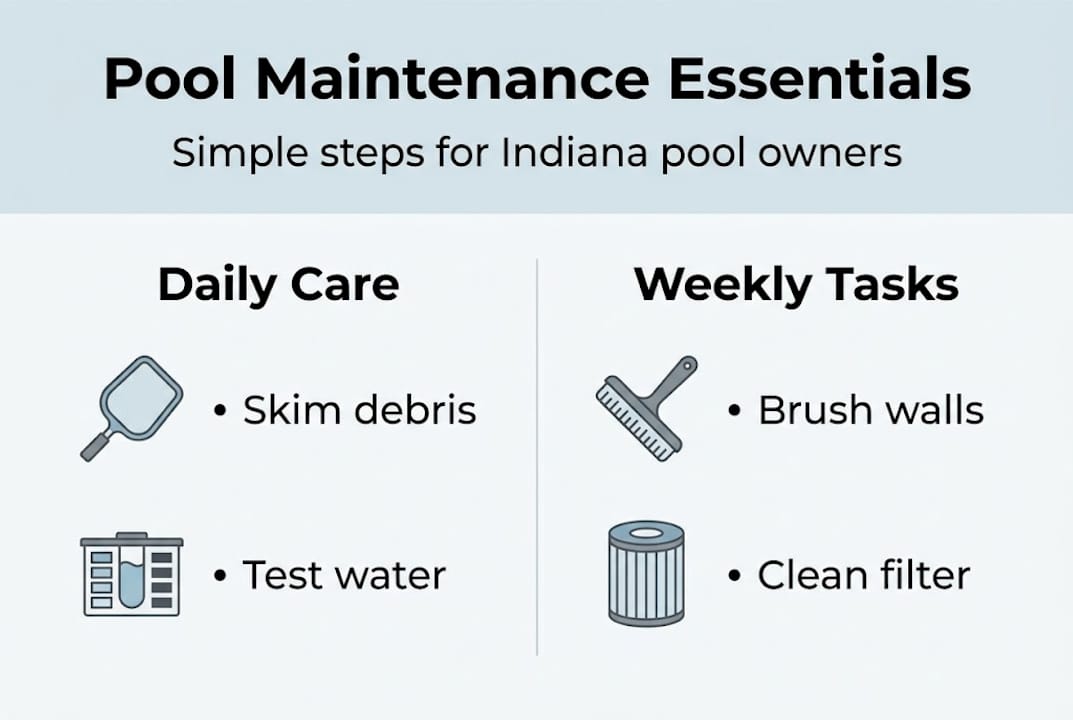
Weekly tasks:
- Skim the surface to remove leaves, insects, and floating debris
- Brush all walls, steps, and corners to prevent algae from taking hold
- Vacuum the pool floor to remove settled dirt and organic matter
- Test the water for pH (target 7.2 to 7.6), chlorine (1 to 3 ppm), and alkalinity (80 to 120 ppm)
- Adjust chemicals as needed based on test results
- Check the pump and filter pressure gauge to confirm normal operation
Monthly tasks:
- Deep clean the filter (backwash sand filters, rinse cartridge filters, or recharge DE filters)
- Inspect all equipment including the pump, heater, and valves for leaks or wear
- Shock the pool with a higher chlorine dose to eliminate built-up contaminants
- Check water level and add water if evaporation has lowered it below the skimmer
Safety note: Waterborne illnesses from poorly maintained pools are preventable. Skimming, water testing, and filter checks prevent costly issues and protect your family’s health. Never let chemical levels slide for more than a few days.
Pro Tip: Add chlorine and other chemicals in the evening rather than midday. Sunlight breaks down unstabilized chlorine quickly, so evening treatments give the chemicals time to work overnight without UV interference.
If you want to reduce the time you spend on manual tasks, self-cleaning pool systems and robotic pool cleaners are worth exploring. Automation and self-cleaning technologies can save major effort, particularly for larger pools or busy families.
Avoiding common mistakes and troubleshooting issues
With routines in place, knowing what to avoid and how to troubleshoot makes your efforts much more effective. Even experienced pool owners slip into habits that quietly cause problems over time.
Most common maintenance mistakes:
- Testing water only when it looks off, rather than on a consistent weekly schedule
- Adding chemicals without measuring first, leading to over or under-treatment
- Ignoring the filter until water flow slows noticeably
- Letting pH drift too high or too low, which makes chlorine far less effective
- Running the pump for too few hours daily, especially during hot Indiana summers
- Skipping brushing because the water looks clear
Most pool owners neglect filter care, leading to cloudy or unsafe water. A clogged filter does not just reduce clarity; it puts strain on your pump motor and can shorten its lifespan significantly.
| Symptom | Likely cause | Fix |
|---|---|---|
| Cloudy water | Poor filtration or low chlorine | Clean filter, shock pool |
| Green water | Algae bloom | Shock heavily, brush, run pump continuously |
| Foamy water | High organic load or soap residue | Shock, check bather load |
| Loud pump | Air in system or worn bearings | Check for leaks, call a technician |
| Burning eyes | pH too low or too high | Test and adjust pH immediately |
| Scale on walls | High calcium hardness | Add a sequestering agent |
Before you add any chemicals, review the maintenance planning questions that help you understand your specific pool type and what it requires.
Critical safety rule: Never mix chemicals directly together, and never add water to chemicals. Always add chemicals to water. Mixing concentrated chemicals can cause dangerous reactions, including fire or toxic gas release.
Seasonal pool maintenance: Opening, closing, and Indiana climate tips
Routine maintenance is only half the picture; seasonal transitions are just as critical for your pool’s longevity. Central Indiana’s four seasons each bring distinct challenges, and preparing for them correctly saves you real money and headaches.
Spring opening checklist:
- Remove and clean the winter cover before storing it
- Inspect the pool shell, liner, and equipment for any freeze damage
- Reinstall any equipment removed for winter storage
- Refill water to the correct operating level
- Run the pump and check all systems for leaks or unusual sounds
- Test and balance the water chemistry before allowing anyone to swim
- Shock the pool and run the filter for 24 hours before the first use
Fall closing checklist:
- Balance water chemistry one final time before closing
- Lower the water level below the skimmer and return lines
- Blow out and plug all plumbing lines to prevent freeze damage
- Add winterizing chemicals to protect water quality over the off-season
- Install a quality winter cover and secure it tightly
- Store all removable equipment indoors
Proper opening and closing extends equipment life and prevents freeze damage. In fact, an estimated 70% of pool damage claims in the Midwest occur during freeze-thaw cycles, making fall closing one of the highest-value tasks of the entire year.
Special tips for Indiana’s seasonal challenges:
- Spring pollen: Run your filter longer daily during peak pollen weeks and clean the filter more frequently
- Summer storms: Test and rebalance chemistry within 24 hours of any heavy rainfall
- Autumn leaves: Use a leaf net over your cover and skim daily during peak leaf fall
- Late freezes: Monitor forecasts in April; a late freeze after opening can damage exposed equipment
For design and planning ideas that take Indiana’s climate into account, the local pool design tips section offers useful guidance.
The truth about pool maintenance: Why simple habits beat fancy gadgets
Let’s zoom out from the checklists and gear to the big picture: what really keeps pools running well, season after season.
We see it regularly. A homeowner invests in an automated chemical feeder, a robotic cleaner, and a smart monitoring system, then stops doing weekly checks because they assume the technology has it covered. Three weeks later, the water is green. The gadgets did not fail; the habit did.
Technology is genuinely useful. Robotic cleaners and automation tools reduce the physical effort of pool care and can catch issues faster than manual checks alone. But they work best as a supplement to consistent habits, not a replacement for them.
The pools we see stay in the best condition year after year belong to owners who do a few simple things every single week without skipping. They test the water. They brush the walls. They glance at the equipment. That is it. No expensive gadget replaces those ten minutes of attention. If you build the habit first and add technology second, you will get the most out of both.
Your partner in pool care
If you want friendly expertise or custom solutions, there are convenient ways to get the support you need.

At Pools of Fun, we have been helping Central Indiana families enjoy their pools since 1981, and we know how much a well-maintained pool adds to your home and your summers. Whether you have a quick question about a chemical imbalance, need help planning your seasonal opening, or want to explore upgrades for your backyard, our team is ready to help. Check out our professional pool maintenance help resources, browse our installation FAQs for answers to common questions, or stop by one of our five Central Indiana locations for free water testing. We make pool ownership easy.
Frequently asked questions
How often should I test my pool water in Central Indiana?
Weekly testing identifies imbalances early, so aim to test at least once per week and always within 24 hours of heavy rainfall, since rain significantly shifts pH and dilutes chlorine levels.
What’s the easiest way to reduce pool algae?
Brush all pool surfaces weekly, maintain chlorine at 1 to 3 ppm consistently, and run your pump long enough each day. Routine cleaning and proper chemical levels are your best defense against algae before it starts.
Do self-cleaning pool systems eliminate all maintenance?
They reduce the workload significantly, but you still need to monitor chemical levels and inspect equipment on a regular schedule. Technology assists but does not replace the human judgment that catches early warning signs.
Is it necessary to close my pool in the winter in Indiana?
Absolutely. Freeze protection is critical in Midwest climates, and a properly closed pool avoids cracked plumbing, liner damage, and contaminated water that can add hundreds or thousands of dollars in spring repair costs.